There is no correct way to teach geography, but there are some best practices. When I began my teaching career in geography 26 years ago in Memphis City Schools, Memphis, TN, the district was focused on concept-based teaching — teaching to the big ideas & conceptual-based learning based upon Lynn Erikson’s concept-based instruction. At first, I found it very challenging to implement this strategy into my lessons as it was a new concept and it significantly varied from the way we had all been presenting content to our students. It took persistence; it took patience, but I believe it was a huge part of why my students enjoyed geography and were able to grasp it. An example of this would be teaching the concept of “human population” and then applying this concept to world population ideas and issues throughout the world such as
- Push and pull factors of migration
- Cartograms, and population density maps,
- Causes and outcomes of population growth and decline
- China’s one-child policies due to overpopulation
- Africa’s population decline,
- Europe’s population decline, etc.
This conceptual-based learning worked well, and students were learning and grasping the concepts and material. It required me to spend more time on the concept with my students, but it gave them a BIG PICTURE of how variables affect population and how population trends work and are influenced. It made them think at higher levels preparing their pathways for high-level learning and working to strengthen their brain connectivity. It gave them a different viewpoint of looking at geography, rather than focusing on one small concept at a time.
Just to give you an idea of how I would/do begin planning each concept-based lesson, I would begin with a brainstorming bubble, and in the center circle, I would type in an essential question. All an essential question (they always have to use big terminology) is an open-ended question that educators use to spark student interest. I say, let’s not make this harder than it has to be. To download a free version of this planning tool, click here:

Here are examples of essential questions specific to geography:
🟢 How have Revolutions impacted our world? (This could be taking a look at the meaning behind “revolution” and empowering student understanding of this “concept” through discussing many different types of revolutions such as the American Revolution, the Industrial Revolution in the United States and Europe, the Russian Revolution, the Cultural Revolution, the Sudanese Revolution, and the Chinese Revolution of 1949.)
🟢 Does music create culture, or vice versa?
🟢 Who is an American?
🟢 How can learning about other cultures teach us about our own?
🟢 What is the relationship between climate and natural resources?
Need an idea for an essential question? There is so much information today on essential questions than there was when I first started teaching. Simply, type into your search engine: “Essential questions for geography.” and then align it with your curriculum. Others have “essentially” (no pun intended) done this work for you over the years.
Let’s stop here. One step at a time so you don’t get overwhelmed with information and practices. Take the first step by practicing writing essential questions for your lessons/units and then look at your curriculum (if you have one) and pick 3-4 topics that will help your students answer this one essential question.
If you want to start with Population Trends, here are some lessons you can use from our store.
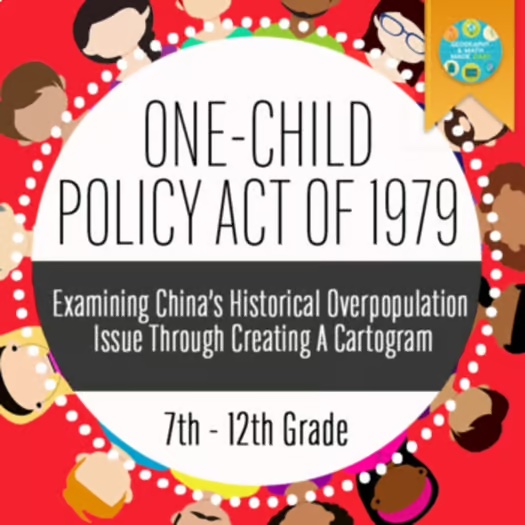

China’s One-Child, Two-Child, Three-Child Policy Acts
Can also be found on Amped Up Learning & Classful


FOLLOW US:
As teachers, we are often overworked and pulled in too many directions. We often put others before ourselves and it is hard to learn to take care of ourselves. Addressing mental health is part of self-care for our minds, bodies, and souls. Remember, if your cup is empty, you can’t fill someone else’s cup. Here are 27 FREE COUNSELING OPTIONS FOR
TEACHERS https://www.weareteachers.com/free-counseling-for-teachers/
FOLLOW US:



 Geography & Math Made Easy