As a geography teacher, I faced a big challenge in deciding what to teach my students. It was one of my biggest stressors in the planning process. How can I cover everything about the world in just one year? Which topics are the most important to focus on? Should my students learn about the different climates in Africa? Or should we focus more time on how different forms of government work throughout Africa? Some districts split geography into Western and Eastern hemispheres, but not all do. It was tough to decide which concepts to prioritize and how to divide up the continents for study.
The district Scope & Sequence Curriculum Map was pretty useful. However, it didn’t give us all the details we needed. It was hard to figure out exactly what to teach for each standard and how long to spend on it. It was nice to have some freedom to choose how or what to teach. However, it was sometimes frustrating because we just wanted someone to tell us how to teach the standard.
Teaching geography is tough because there’s so much to learn! You start with simple stuff like where countries are on a map. Then you move to more complicated things like weather patterns and how people interact with the environment. It’s challenging to choose what to focus on. Additionally, teaching it effectively so that every student understands can be difficult. We have to find a balance between just memorizing facts and actually thinking about what it all means.
So, What is the Answer?
As you well know, teaching Geography is not like teaching other subjects.. The world is everchanging. There are many historical events to cover, along with cultural aspects. Economic, social, and political aspects of regions also need attention. Should we spend our limited time on the Tiananmen Square Massacre, which involves communism and martial law? Or should we focus on the One Child Policy under Mao Zedong, which explores communism and population control? It can be overwhelming to decide where to focus our time. I think the answer is to teach through a different approach: teaching a concept with a big idea in mind.
Teaching With A Big Idea Concept
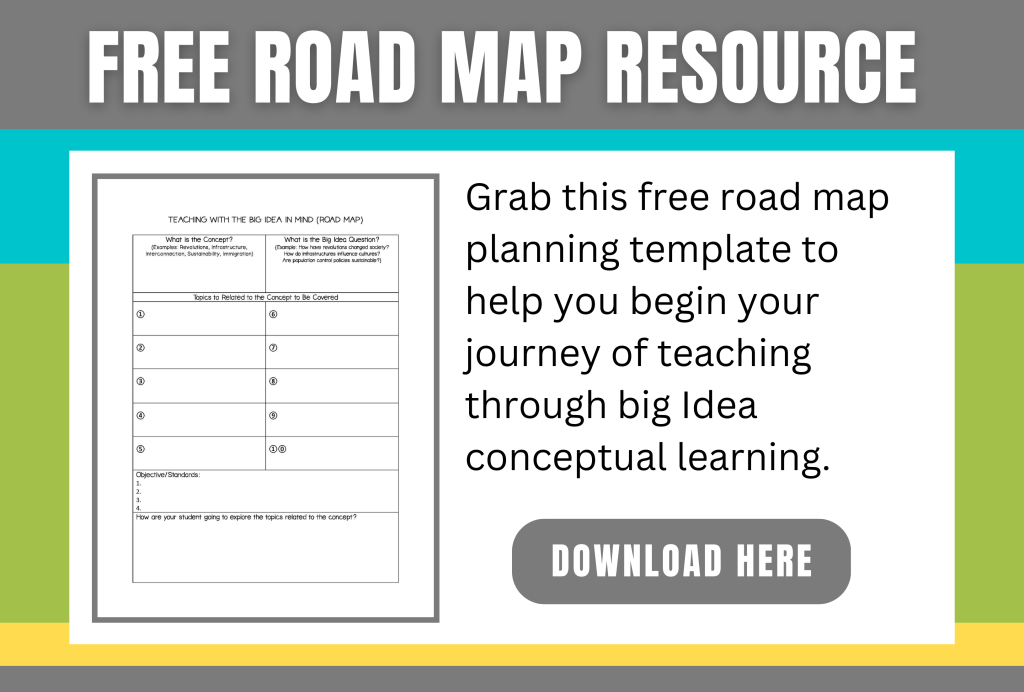
① The first step is to formulate a question based on the concept you have chosen. At first, this may seem complicated. However, it is as simple as defining what you want your student to fully understand. Also, consider the knowledge you want your students to walk away with. Ask yourself, “What do I want my students to understand about revolutions?” The big idea question may sound something like this: “How have revolutions changed society?” or “What triggers a revolution?” Pose this question to your students. Let them think about it or discuss it with their groups, and then have an open discussion about it. Here are a few examples of revolutions you may want to cover:
② The second step is to examine revolutions around the world throughout history. What are events around the world that are considered “revolutions”?
- ✅ Industrial Revolution: European Industrial Revolution (mid 1800s) and American Industrial Revolution (early 1990s).
- ✅ Scientific Revolution: Marked by rapid scientific advances in Western Europe. (1500s-1700s)
- ✅ Mao Zedong Great Leap Forward: A social/economic campaign in China from 1958 to 1962.
- ✅ Allied invasions of Italy in 1943 and of Germany in 1945 during WWII: marked a significant turning point in World War II, ultimately led to their surrender of Europe.
- ✅ Russian Revolution of 1917: Period of political and social change in Russia that began in 1917 and led to the establishment of the world’s first socialist government.
③ Identify Objectives & Plan Your Lesson Around the Big Idea Question. You may have carousel stations, one station focusing on a revolutions throughout history and world. Or, you may assign student groups one of the revolutions to cover. Then, have them participate in a pair and share. There are many techniques you. can use in your lesson. Choose what works for your students.

What. do you want to know about teaching through big-idea conceptual learning? Post your comments in the comment section.
Sign Up for our Newsletter Here:
FOLLOW US:
Follow us on our social media accounts and various teacher resource platforms. Simply click the icons below and follow or like us.
Online Stores


Social Media


#geographyandmathmadeeasy#teachertherapy#therapy#geography#middleschool#highschool
 Geography & Math Made Easy